

Cancer is one of the leading causes of death in the United States, second only to heart disease. According to the Centers for Disease Control and Prevention (CDC), cancer was responsible for 619,876 deaths in 2024, with an additional 683,491 attributed to heart disease in that same year.
Texas A&M University nuclear chemist Dr. Sherry J. Yennello and her research group in the Cyclotron Institute are working to change that with the help of cyclotron beams and novel chemistry. As director of the Cyclotron Institute, she oversees a leading U.S. program in developing alpha-emitting radioactive isotopes that are transforming nuclear medicine as an effective treatment for inoperable tumors. In recent years, her research group has perfected routine production, separation and distribution of astatine-211, a short-lived alpha-emitting radioisotope that shows strong promise as a strategic therapeutic weapon against cancer.
“Targeted alpha therapy is a potentially transformative cancer therapeutic of great interest due to its ability to cause large amounts of damage near a tumor cell while keeping the healthy surrounding tissue and organs intact,” explained Yennello, a Distinguished Professor and Regents Professor of Chemistry at Texas A&M. “We are one of a handful of U.S. centers capable of routinely producing astatine in medically relevant quantities and delivering it to nearby facilities.”

The Astatine Advantage
When astatine decays, it emits alpha particles, which are formed by the combination of two protons and two neutrons. For a variety of reasons, these alpha particles are highly effective at delivering potent energy capable of killing cancer cells. Unlike other types that can penetrate deeper into the body, damaging both healthy and cancerous tissue, alpha particles only travel a short distance before depositing their cell-destroying energy payload. Thus, when At-211 is positioned in or near cancerous tissue, its emitted alpha particles travel deep enough to destroy the cancer cells but leave surrounding healthy tissue minimally harmed.
Because of At-211’s short half-life, it loses its radioactivity quickly and therefore is less toxic than other longer-lived radiopharmaceuticals. In particular, At-211’s absence of secondary alpha decay radioactivity is key in maximizing its cancer-killing energy and efficiency, making it an attractive prospect for researchers and drug makers throughout the world. Already, it is being pioneered as an alpha-emitting treatment option in clinical trials for blood cancers and even explored in early-stage research and development for Alzheimer's disease.
“Astatine-211’s availability remains the biggest hurdle to harnessing its potential to transform the future of nuclear medicine,” Yennello said. “Fortunately, the advances we’re making here at Texas A&M will go a long way toward addressing that.”

Astatine-211 On Demand
The Yennello Group initially began producing At-211 using Texas A&M’s K150 cyclotron in December 2019. Within months, her team discovered a useful interaction between At-211 and a class of chemicals known as ketones, which led to their 2021 development of a high-yield production, purification and recovery method for At-211 that takes minutes rather than hours. In the years since, Yennello and her group have continued to work with collaborators across the nation to learn more about the behavior and reactivity of shipped At-211 while perfecting their recovery and activation methods.
Texas A&M is currently one of two national suppliers of astatine through the National Isotope Development Center as a featured member of its University Isotope Network since 2023. Yennello and her team regularly provide At-211 to multiple research groups across the state of Texas and nation, including the University of Alabama at Birmingham, MD Anderson Cancer Center, the University of Texas Southwestern Medical Center and UTHealth Houston, where researchers can tailor it to their own chemical uses while exploring its radiopharmaceutical properties and therapeutic potential.
Universal Benefits of Nuclear Reactions
Yennello, who holds the Cyclotron Institute Bright Chair in Nuclear Science, originally came to Texas A&M because of her interest in the Cyclotron Institute, a Department of Energy University Facility that she has been a member of for 33 years and has led since 2014. An internationally renowned nuclear chemist and expert in heavy-ion reactions, she is recognized among the top 0.5% of researchers in nuclear chemistry and has made transformational contributions to our understanding of nuclear reactions induced by radioactive nuclei. She is also a global authority in the use of isotopically selected beams to explore the dynamics and thermodynamics of nuclear collisions, including one of the first-ever experiments induced by a radioactive beam.

“My research is focused on working to understand the forces that govern the universe and then using that knowledge to benefit society,” Yennello added. “As a nuclear chemist, I study nuclear reactions and the properties of neutron-rich matter to determine how the elements of the periodic table were made within the stars. By developing a more robust understanding of the chemical evolution of our universe, we can better understand how this knowledge — and nuclear collisions — can be applied to improving the human quality of life and enriching the human experience.”
Yennello is a fellow of the American Chemical Society (ACS), the American Physical Society (APS) and the American Association for the Advancement of Science. Her transformational research has been recognized with the ACS’s highest honor in her field — the ACS Glenn T. Seaborg Award in Nuclear Chemistry — as well as the ACS Garvin-Olin Medal. Her many national career awards to date include the Sigma Xi National Young Investigator Award, the National Science Foundation Young Investigator Award, the Oak Ridge Associate Universities Junior Faculty Enhancement Award, the APS Division of Nuclear Physics Mentoring Award, and the Southeastern Universities Research Association Distinguished Scientist Award.
Earlier this year, Yennello was honored with her most recent award, the Texas A&M Association of Former Students Distinguished Achievement Award for Research. She is one of five Texas A&M faculty who have earned Distinguished Achievement Awards in three different categories, having previously been recognized for Teaching at both the university and college levels in 2012 and 2008, respectively, and for Administration in 2019. In addition, she has earned the Texas A&M Women’s Faculty Network Outstanding Mentor Award.

‘Fascinating World of the Nucleus’
When asked about her own mentors, Yennello credits her high school science teacher, Judy Haduch, for introducing her to the “fascinating world of the nucleus” during a nuclear chemistry course — work that she says was followed up by Ivor Preiss, whose laboratory she worked in as an undergraduate student at Rensselaer Polytechnic Institute. After earning her Ph.D. in nuclear chemistry at Indiana University, she spent two years as a postdoctoral fellow at Michigan State University before beginning her independent academic career at Texas A&M, where she sees infinite possibilities inherent in the many inquisitive students, excellent staff and top-notch facilities — chief among them the one she leads and loves.
“The Cyclotron Institute is a wonderful and unique facility that provides the infrastructure for discovery science in many areas,” she added. “In the process of delivering applications that benefit society, from producing medical isotopes for cancer treatment to testing for radiation resilience of electronics, we’re also developing the next generation of scientists and helping to supply the nation’s future workforce in areas that are critical to global innovation and advancement.”
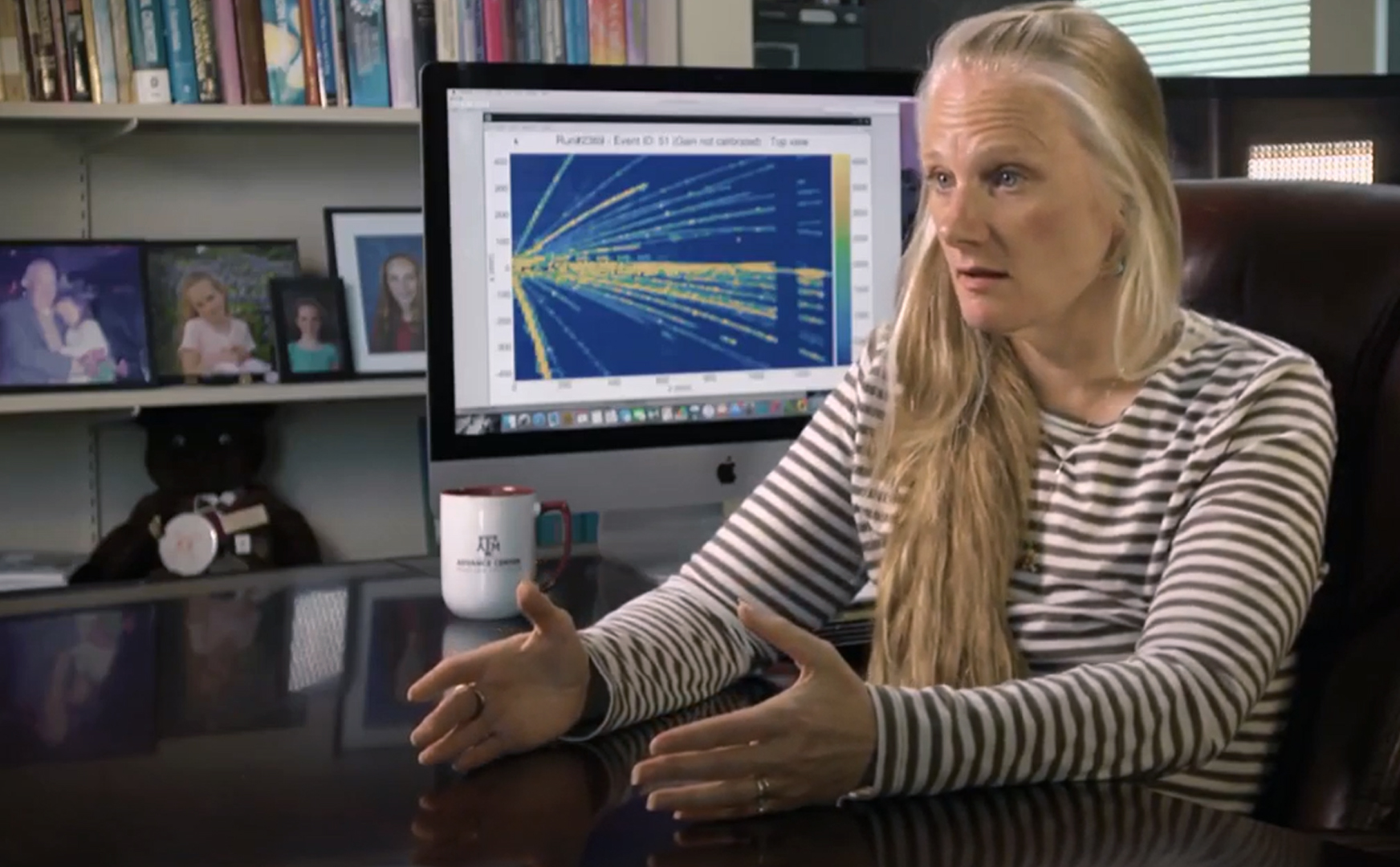
Looking back through the years and reflecting on the myriad memories and milestones, Yennello says she is exceptionally grateful for a career goal fulfilled — getting to “do cool science” — and the many people she has gotten to know and work alongside in the process.
“To date in my career, I am most proud of and for the people whose lives have been positively impacted, from undergraduates in my classes and research group, to graduate students, staff and faculty as well as the numerous people outside of Texas A&M of all ages across the state, nation and world.
“I get to work with amazing people every day, and I am always learning something new.”