
- Associate Professor
- Phone: (979) 862-3038
- Email: aearhart@tamu.edu
- Office: LAAH 469
- Document: CV
- Personal Website
- 19th-Century American
- 20th-Century American
- African American and African Diaspora Literature
- Book History
- Digital Humanities
- Information Studies
- Material Culture Studies
- Race and Ethnicity Studies
Biography
Amy E. Earhart is Associate Professor of English and affiliated faculty of Africana Studies at Texas A&M University. She is a recipient of a NEH-Mellon Fellowship for Digital Publication and a NEH Summer Stipend as well as local awards for her research, the Texas A&M University Presidential Impact Fellow and Texas A&M University Arts & Humanities Fellow. Her teaching has been recognized by the Association of Former Students Distinguished Achievement Award-Teaching and the Montague-CTE Scholar Teaching Award. In addition, Earhart’s work in public humanities has included work with Humanities Texas, both through board membership and participation in teacher training workshops, and with community members to document the Millican Massacre, for which she was honored by the Brazos Valley African American Museum in 2025.
Involved with digital humanities scholarship since 2003, Earhart’s scholarship has focused on examining infrastructures of technology and their impact and replication of “race,” building infrastructure for digital humanities work, embedding digital humanities projects within the classroom, and tracing the history and futures of dh, with a particular interest in the way that dh and Black studies intersect. Her digital projects are constructed to expand access to Black humanities materials, as is the case with projects The Millican Massacre, 1868, DIBB: The Digital Black Bibliographic Project, and “Alex Haley’s Malcolm X: ‘The Malcolm X I knew’ and notecards from The Autobiography of Malcolm X” (a collaborative project with undergraduate and graduate students published in Scholarly Editing).
Earhart has published scholarship on a variety of digital humanities topics, with work that includes a monographs Digital Literary Redlining: African American Anthologies, Digital Humanities, and the Canon (Stanford UP 2025), Traces of Old, Uses of the New: The Emergence of Digital Literary Studies (U Michigan Press 2015), a co-edited collection The American Literature Scholar in the Digital Age (U Michigan Press 2010), and a number of articles and book chapters in volumes including the Debates in Digital Humanities series, DHQ, DSH: Digital Scholarship in the Humanities, Digital Studies/Le champ numérique, and Textual Cultures.
She is at work on a monograph "The Millican Massacre: Networked Racial Violence and Archival Restitution.”
Research Interests
- Digital humanities
- Africana and African American literature
- 19th-century American literature and culture
Research Areas
- Race and Ethnicity Studies
- African American and African Diaspora Literature
- Digital Humanities
- Material Culture Studies
- 20th-Century American
- Book History
- Information Studies
- 19th-Century American
Educational Background
- Ph.D., Texas A&M University, 1999
- M.A., The University of Tennessee, 1993
- B.A., Lebanon Valley College, 1991
Awards & Honors
- 2024-2025: “The Millican Massacre: Newspaper Transmission and Extension of Reconstruction Racial Violence.” Kate B. and Hall J. Peterson Short-Term Visiting Fellowship. American Antiquarian Society. Worcester, Massachusetts.
- 2020: NEH-Mellon Fellowship for Digital Publication conferred by National Endowment for the Humanities – (Washington D.C., District of Columbia, United States) – for “Digital Humanities and the Infrastructures of Race in African-American Literature.”
- 2020: Presidential Impact Fellowship. Texas A&M University.
- 2019: Arts & Humanities Fellow. Division of Research. Texas A&M University.
- 2009: “The Center for Digital Humanities, Media, and Culture,” with Maura Ives, Patrick Burkhart, Margaret Ezell, James Harner, et al. The White Paper Research Roadmap Competition, Texas A&M University. (approximately $2,500,000 over 5 years)
- 2007: NEH Summer Stipend. Reports of the Selectmen and Other Officers of the Town of Concord (1841-1865). The 19th-Century Concord Digital Archive. National Endowment for the Humanities.
Selected Publications
Digital Literary Redlining: African American Anthologies, Digital Humanities, and the Canon. Text/Technologies Ser. ed. Elaine Treharne, Ruth Ahnert and Roopika Risam. Palo Alto: Stanford University Press, 2025.
Though canon concerns seem to be a relic of 1990s academia, we are, once again, at a historical moment when there is resistance to teaching texts by writers of color and texts that deal with race, ethnicity and gender. At the same time, algorithmic bias scholars are locating systemic bias encoded into systems from policing software to housing software. Bringing these divergent areas together, Amy E. Earhart examines how technological and institutional infrastructures construct and deconstruct race, ethnicity and gender identities.
Focusing on two central infrastructures, the database, a commonly used technological infrastructure in the ditital humanities, and the anthology, a scholarly and pedagogical infrastructure, Earhart considers how such seemingly naturalized infrastructures impact the representation and modeling of identity. The book draws upon the building and use of DALA, a collection of almost 100 years of generalist American and African American literature anthologies, constructed to investigate questions of identity and representation in literary anthologies and, by extension, the larger literary canon. The resulting examination, and its rigorous discussion of how identities are created and recreated within Black literary histories, has important implications for contemporary cultural and political debates about canon formation, literary scholarship, and the bias embedded in technological infrastructures.
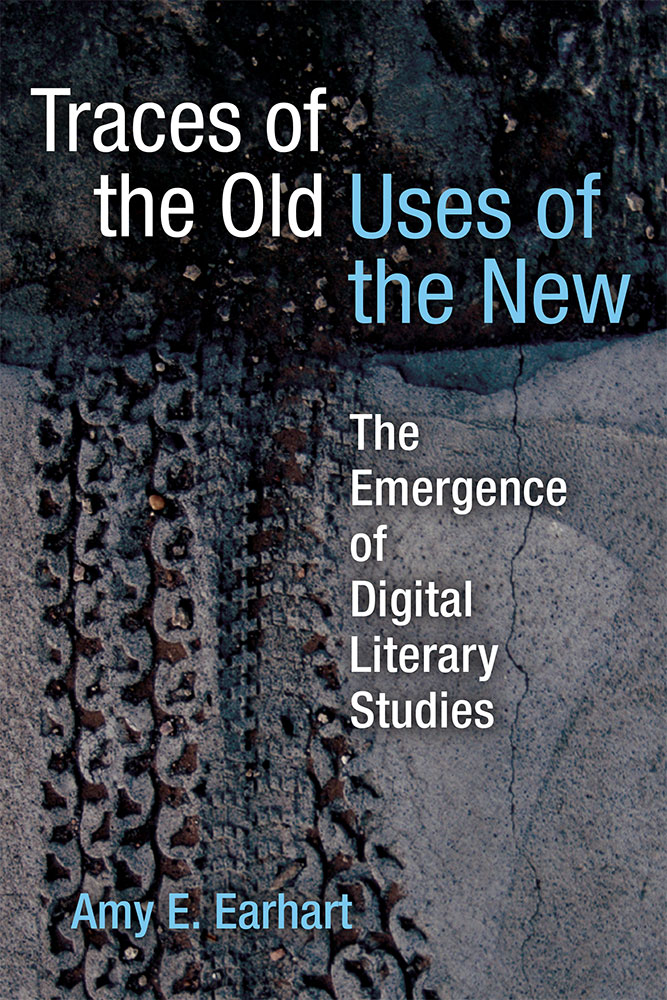
Earhart Amy E. Traces of the Old, Uses of the New: The Emergence of the Digital Literary Studies; University of Michigan Press, 2015.
Traces of the Old, Uses of the New focuses on twenty-five years of developments, including digital editions, digital archives, e-texts, text mining, and visualization, to situate emergent products and processes in relation to historical trends of disciplinary interest in literary study. By reexamining the roil of theoretical debates and applied practices from the last generation of work in juxtaposition with applied digital work of the same period, Earhart also seeks to expose limitations in need of alternative methods.
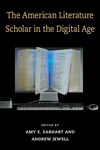
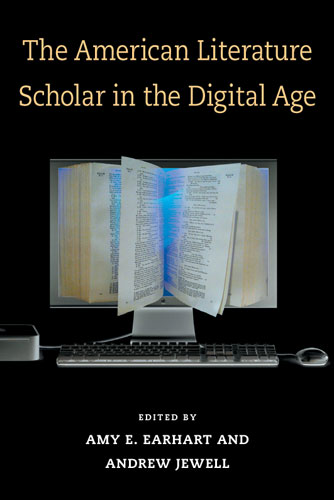
Earhart, Amy E. The American Literature Scholar in the Digital Age. University of Michigan Press, 2010.
The American Literature Scholar in the Digital Age, which features a wide range of practitioner-scholars, is the first of its kind: a gathering of people who are expert in American literary studies and in digital technologies, scholars uniquely able to draw from experience with building digital resources and to provide theoretical commentary on how the transformation to new technologies alters the way we think about and articulate scholarship in American literature.
Other Publications
- “DALA, The Database of African American and Predominantly White American Literature Anthologies.” Journal of Open Humanities Data, vol. 11, no. 1, Apr. 2025. metajnl.com, https://doi.org/10.5334/johd.298.
- “Feminist Digital Humanities.” The Bloomsbury Handbook to the Digital Humanities. Ed. James O’Sullivan. New York: Bloomsbury Academic Press. 73-80. 2022. Invited.
- “An Editorial Turn: Reviving Print and Digital Editing of Black-Authored Literary Texts.” The Digital black Atlantic. Debates in Digital Humanities Series. Ed. Roopika Risam and Kelly Baker Josephs. Minneapolis, U Minnesota P, 2021. 69-95. Invited.
- With Roopika Risam and Matthew Bruno. “Citational Politics: Quantifying the Influence of Gender on Citation in Digital Scholarship in the Humanities.” DSH: Digital Scholarship in the Humanities.
- "Digital Humanities within a Global Context: Creating Borderlands of Localized Expression.” Fudan Journal of the Humanities and Social Sciences. 5.17. 1-13. 2018.
- “Can we Trust the University?: Digital Humanities Collaborations with Historically Exploited Cultural Communities.” Bodies of Information: Intersectional Feminism and Digital Humanities. Ed. Elizabeth Losh and Jacqueline Wernimont. Minneapolis: U Minnesota P, 2018. 369-390. Invited.
- With Toniesha Taylor. “Pedagogies of Race: Digital Humanities in the Age of Ferguson.” In Debates in Digital Humanities, 2016. Ed. Lauren Klein and Matthew Gold. Minneapolis: U Minnesota P, 2016. 251-64. Print and Digital. Refereed.
- “Digital Humanities Futures: Conflict, Power, and Public Knowledge.” Digital Studies/ Le Champ Numerique. Special issue: Congress 2015. Ed. Jon Saklofske, Susan Brown and Padmini Ray Murray. 2016. Invited.
- “The Digital Humanities as a Laboratory.” In Humanities and the Digital. Ed. David Theo Goldberg and Patrik Svensson. Boston: MIT P., 2015. 391-400. Invited. Refereed.
- “Can Information be Unfettered?: Race and the new Digital Humanities Canon.” In Debates in Digital Humanities. Ed. Matthew Gold. Minneapolis: U of Minnesota P., 2012. 309-18. Print. Invited. Refereed. Reprint expanded version, online open access.
Selected Digital Projects
- The Millican “Riot,” 1868 http://millican.omeka.net
- The Database of African American and Predominantly White American Literature Anthologies (DALA).
- Data: https://dataverse.tdl.org/dataverse/DALA;
- Observable Plot Visualizations:
-
-
- Authors: https://observablehq.com/d/7774c0b27f80ef63;
- Anthologies: https://observablehq.com/d/56f95000aad79eb6.
-
Please be aware that this tool was built as an experimental interface. If does take a time to load because of the size of the dataset.
Editor of Special Issues of Journals
- DH and American Studies. Ed. Lauren Tilton, Amy Earhart, Matthew Delmont, Susan Garfinkel, Jesse P. Karlsberg, and Angel David Nieves. Spec. issue of American Quarterly. 70.3 (2018).
- Digital Textual Studies: Past, Present and Future. Ed. Amy Earhart and Maura Ives. Spec. issue of DHQ: Digital Humanities Quarterly. 3.3 (2009). n. pg. Web.