

Every successful project, proposal or program starts with a plan, and the Center for Excellence in Nuclear Training And University-based Research (CENTAUR) is no exception.
Led by the Cyclotron Institute at Texas A&M University, this seven-institution collaboration was founded in 2018 through a Stewardship Science Academic Alliances Center of Excellence Program grant from the Department of Energy (DOE)/National Nuclear Security Administration (NNSA). CENTAUR works in tandem with national laboratory partners across the country to provide the research experience necessary to develop next-generation leaders in stewardship science for low-energy nuclear science to support workforce development and research-related needs relevant to the NNSA’s stockpile stewardship goals.
But even the best-laid plans are subject to change, an adaptability that recently enabled CENTAUR researchers to capitalize on one of the collaboration’s greatest strengths: flexibility.
Answering Mission-Relevant Questions

For nearly two decades, experimental nuclear astrophysicist Dr. Aaron Couture has worked at Los Alamos National Laboratory’s Los Alamos Neutron Science Center (LANSCE) alongside his graduate mentor and colleague Dr. René Reifarth, where they use one of the nation’s most powerful linear particle accelerators to study neutrons and their impact on the evolution of elements and, in turn, our universe. Their goal is to apply that knowledge to answer mission-relevant questions, such as what happens during nuclear explosions and within nuclear reactions in general.
As a CENTAUR-affiliated scientist and collaborator in Texas A&M’s DAPPER experiments, Couture specializes in the experimental study of neutron capture, which is responsible for the production of almost all the observed elements heavier than iron. Nuclear waste transmutation concepts rely on neutron capture to reduce long-lived radionuclide inventories, while nuclear forensics also relies on understanding neutron reaction networks. Where possible, these reactions are measured directly with neutron beam facilities such as LANSCE — measurements that are complemented by nuclear structure studies using rare isotope beams. Such structurally significant information is used to inform and guide nuclear reaction modeling that is used to predict neutron capture reaction rates as well as predictions of stability.
In recent years, Couture and Reifarth have been exploring neutron targets — a challenging yet tantalizing prospect ripe with new experimental opportunities, including potential discoveries related to nucleosynthesis, stockpile science and reactor design. The scientists have theorized that a neutron target intersected by an ion storage ring would allow for measurements of neutron-induced reactions on radioactive nuclides. However, because every re-scattering provides a possibility for the neutron to travel back through the target volume, neutron moderation is essential to optimizing the neutron density and energy distribution.
Connections In Collaboration

Once Couture and Reifarth succeeded in developing a model of neutron moderation this past fall, they needed a collaborator with both the expertise and infrastructure required to test it. Based on Couture’s CENTAUR ties, they knew precisely who to contact: Texas A&M nuclear chemist and CENTAUR principal investigator Dr. Sherry J. Yennello, who serves as director of the Cyclotron Institute, a DOE University facility and one of five DOE Centers of Excellence that is home to one of only five K500 or larger superconducting cyclotrons worldwide.
Although their model had already been benchmarked at low energy using proton beams to produce neutrons at the University of Notre Dame, Couture and Reifarth needed a suitable facility capable of executing the next critical step in the process: testing at high energies. In December, they traveled to the Cyclotron Institute, where they teamed with research scientist Dr. Alan B. McIntosh and additional members of the Yennello research group in using K150-cyclotron-generated beams to produce neutrons from a beryllium target surrounded by an 80-centimeter cube of graphite to moderate the neutrons. Gold wires were arranged on a line through the center of the cube that spanned its width to account for the reaction cross sections, which are known to contain thermal and higher-energy neutrons.
Following irradiation, the researchers used high-purity germanium detectors to measure gamma rays from the gold wires to determine the activity of any resulting gold products. In addition to using two beam energies, 9 and 45 megaelectron volts (MeV), the team configured the graphite cube two different ways for each respective beam energy: as a full cube and with the top half removed to increase the fast-to-thermal neutron ratio.
‘Striking Good Agreement’
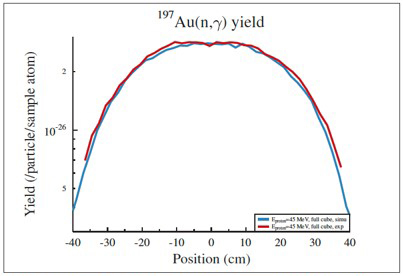
In comparing the model’s predicted yield (calculated using knowledge of the energy-dependent neutron-induced reaction cross sections within the moderator) to the measured yield as a function of its position, the team found “striking good agreement” using the full cube at 45 MeV, as illustrated in their preliminary simulation.
“Agreement is also observed in preliminary analysis of the other reactions, other beam energy and other moderator configuration,” Reifarth explained. “The moderator model is accurate and can play a reliable role in the development of a neutron target.”
The team expects to publish their results in a peer-reviewed journal, but for the moment, they are content in being able to capitalize on the exponential power of relationships and maximizing the opportunity inherent in both what and who you know.
The work was funded primarily by the U.S. Department of Energy/National Nuclear Security Administration under award numbers DE-NA0003841 and DE-NA0004150.
Learn more about CENTAUR or the Cyclotron Institute research program.
A condensed version of this story was originally published in the September 2025 issue of the National Nuclear Security Administration Academic Programs Quarterly.