Skip To Main Content

CACE has a designated CACE laboratory (Eller O&M B07), and a designated secure parking space for and dedicated outdoor 240 V outlet inside the locked fenced-in area at the GERG (Geochemical Environmental Research Group) facility, and a shared roof sampling platform for local atmospheric measurements on the roof of Eller O&M.

AggieRad is a new facility at Texas A&M University for the characterization of radioactive materials. The AggieRad proposal was funded by Texas A&M University Research Development Fund.

What is ICP-MS? ICP-MS is an instrumental method for measuring chemical elements at very low concentrations in water-based solutions, and it can be applied to nearly any material that can be adequately dissolved in water.

photo of students in classroom

CCCA: Nano-Analysis Competence

The Center for Chemical Characterization and Analysis (CCCA) provides services in the areas of trace and bulk elemental analysis to TAMU researchers and customers at other academic institutions, government agencies, and private industry.

Cutting edge research often requires the design and fabrication of customized glassware and specialized instrumentation. Experienced, expert staff are available to assist all departmental researchers. In-house IT staff are also available to provide support for computer hardware, software, network connectivity and other related issues.

GeoInnovation is a Texas A&M technology service center directed by Dr. Daniel Goldberg and is composed of a team of skilled faculty and students from various disciplines. Our mission is to provide best-in-class software solutions for cross-domain research applications.

The Geochemical and Environmental Research Group (GERG) is a center of excellence in applied geosciences within the College of Arts & Sciences of Texas A&M University. GERG, founded in 1981, focuses on applied interdisciplinary research in the ocean and environmental sciences.

The Human Imaging Facility meets the Magnetic Resonance Imaging (MRI) needs of the research community at Texas A&M University. State-of-the-art imaging is supported by our research-dedicated Siemens 3T Prisma magnet. From changing and waiting rooms to equipment and space for pre- and post-scan assessment, we provide comprehensive support for MRI projects.

The LSBI is designed to be a multi-user laboratory supporting major research initiatives within the Chemistry Department, the university and extending to the broader academic and industrial scientific communities.

The ILSB-MSL is staffed by highly skilled technical staff and state-of-the-art instrumentation to provide advanced MS research capabilities to support a broad range of molecular-level research and develop projects and train scientists to advance the field of mass spectrometry to new levels. The ILSB-MSL specializes MS in peptide mass mapping, protein ID, proteomics and lipidomics, as well as

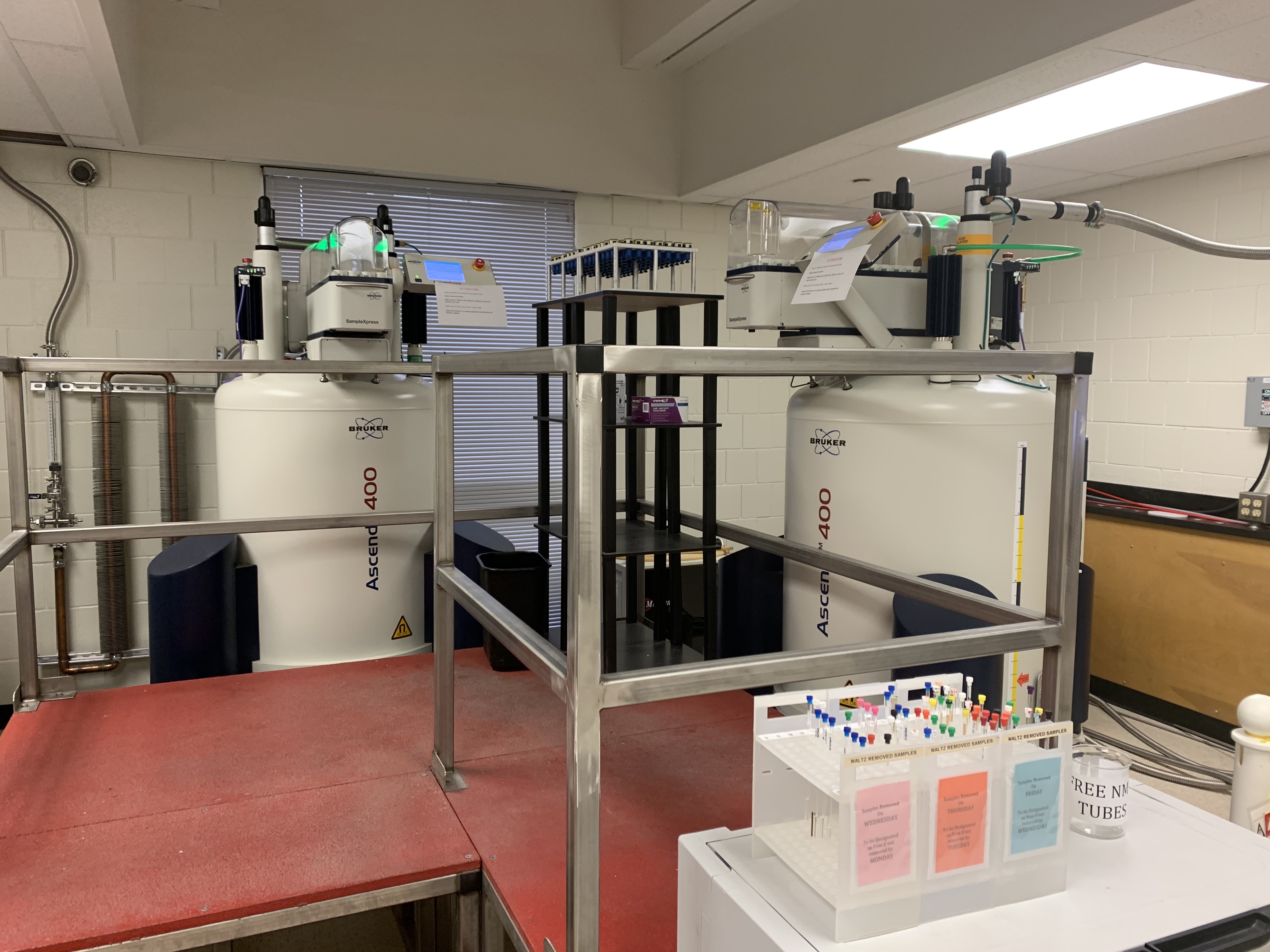
Our facility includes 8 NMR spectrometers, an EPR, a Helium Recovery Facility, and 3 full-time staff positions. Although this facility is physically housed within the Chemistry Department, we provide services to the entire TAMU community and beyond.

The R. Ken Williams ’45 Radiogenic Isotope Geosciences Laboratory at Texas A&M is a 1550 ft two laboratory complex that consists of a perchloric acid fume hood room, gown-up room, dilution and weighing room, clean general chemistry room, and ultra-clean chemistry room.

The primary focus of the Texas A&M Drug Discovery Center is to guide targets identified by investigators through the drug discovery process and to facilitate the transition from basic research studies to drug discovery.

Welcome to the X-ray Diffraction Facility in the Department of Chemistry at Texas A & M University. We are a full service X-ray Diffraction laboratory offering state of the art instrumentation for the analysis of solid materials. Our services include single-crystal and powder diffraction for Chemistry, Material Sciences and Pharmaceuticals.