Overview
Demography is the study of the basic demographic processes of fertility, mortality, and migration and their relationships with and consequences for population distributions of various kinds including age and sex composition and the spatial distribution of population.
The subfield of social demography examines the intersection of demography with social distributions and dynamics, particularly population composition and differences in demographic distributions by race/ethnicity and socioeconomic status.
Demographic analysis draws on specialized data and a specialized set of techniques, methods and models including life table analysis; survival analysis; measurement of demographic rates, ratios, and population composition; stable population theory; decomposition analysis; mathematical and simulation models; and a wide range of related methods and techniques of analysis.
Examples of topics studied include trends in population growth and how it is shaped by the components of fertility, mortality, and migration; spatial distribution of population; immigration; age and sex composition of the population; residential segregation of social groups including racial and ethnic groups and socioeconomic groups; socioeconomic distributions, poverty, and inequality; and how social outcomes of different kinds are impacted by demographic distributions and processes.
The Demography Group in the Sociology Department is highly accomplished with many publications in influential scientific and scholarly journals and many externally funded research projects. The group has particular strengths in the immigration and migration, demography of racial and ethnic groups, and demographic aspects of segregation, poverty, and socioeconomic inequality.
Texas Research Data Center (TXRDC)
Opportunities to conduct advanced demographic research are enhanced by the presence of the Texas Research Data Center (TXRDC) on campus. The TXRDC, one of about 30 Federal Statistical Research Data Centers located around the country, makes it possible for graduate students and faculty to work with restricted-access versions of important datasets in the federal statistical system.
Pathways for Undergraduate Students
Undergraduate students find coursework in demography has direct value for the important topics the field covers and also find demography complements a wide range of interests and majors. Coursework in demography can be helpful for applied positions in business, public policy and non-profits, and local, state, and federal government. Many sociology undergraduate students with coursework in demography go on to graduate programs in sociology, public health, urban planning, and public policy.
Pathways for Graduate Students
Graduate students specializing in demography are able to pursue a wide range of opportunities in academic settings, in business settings, in public policy research, and in local, state, and federal government. Many of our department’s Ph.D. graduates specializing in demography hold positions in universities and colleges and in local, state, and federal government including leadership positions at the U.S. Census Bureau.
Major and Minor in the PhD Program
According to the new guidelines of the Sociology Graduate Program, doctoral students declare a major (three courses) and a minor (one course) from any of the American Sociological Association (ASA) sections. The Demography area relates to the Section on Sociology of Population.
Undergraduate Courses
- SOCI 312 Population and Society
- SOCI 320 Demographic Methods
- SOCI 337 International Migration
- SOCI 338 Latino Immigration
Graduate Courses
- SOCI 622 Social Demography
- SOCI 632 Migration
- SOCI 633 Demographic Methods
- SOCI 642 Fertility and Mortality
- SOCI 647 Seminar in Demography and Human Ecology: Selected Topics
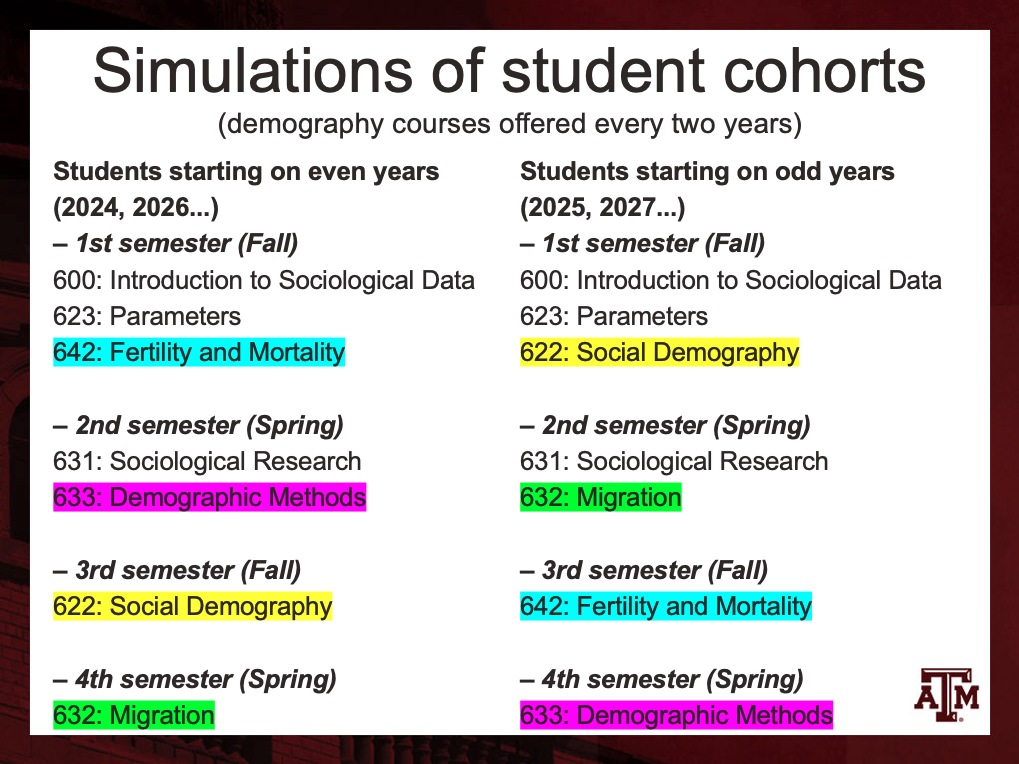
Timeline of Graduate Courses
The timeline about graduate courses in Demography and additional information are available in the following document and figure.